
Red clay, long seasons, summer storms
Hydroseeding in Greenville, SC
New lawns, slope cover and sediment control for Upstate yards and job sites, sprayed on the right calendar.
- We walk your site at no cost and put the quote in writing
- Seed mix chosen for your sun, shade and season
- Silt fence, blankets and grading handled by one crew
Getting Grass to Hold on Upstate Ground
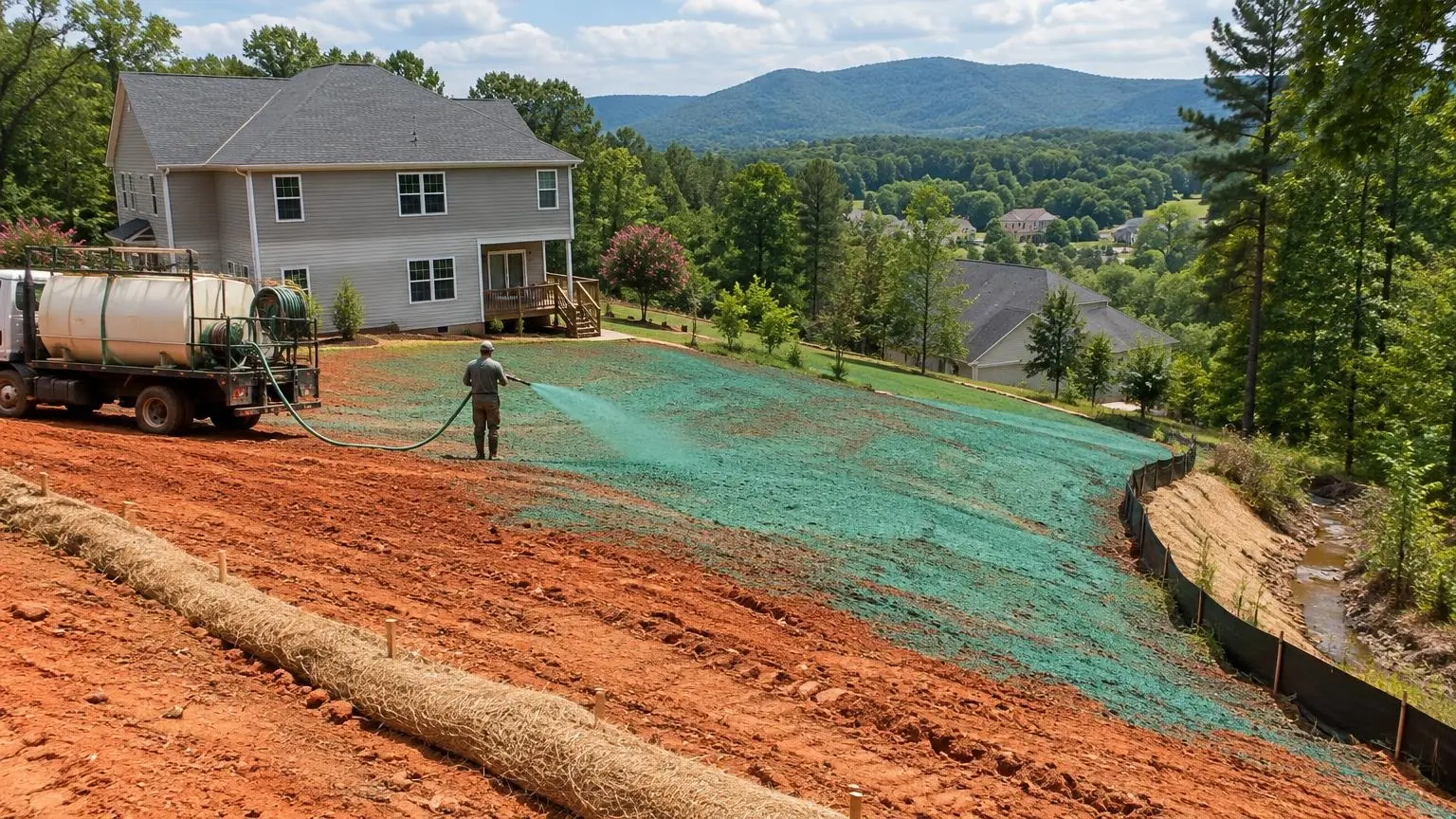
Hydroseeding in Greenville is the practice of spraying seed, wood fiber mulch, fertilizer and a tackifier together as one wet mix onto prepared soil, so a lawn or a slope can root fast, before the next storm moves the dirt. Greenville sits in the foothills of the Blue Ridge, and the city takes in many small hills, with Paris Mountain rising about 8 miles north of downtown and the Reedy River cutting through the center of town. Those hills, a long growing season and plenty of rain shape every job we price. We hydroseed new lawns, cover cut banks and pond slopes, put up silt fence and inlet protection, fine grade and spread topsoil, and renovate thin lawns across Greenville County and the neighboring Upstate counties.
The clay under the grass
Much of the Piedmont from Virginia to Alabama, South Carolina included, is mapped as Cecil soil. A typical Cecil profile has a few inches of brown sandy loam on top and then red, sticky clay that runs two to four feet deep. Decades of farming and erosion stripped the topsoil off a lot of that ground before houses were built on it, and grading on a new lot usually scrapes away whatever was left. Kaolinite clay like this has little ability to recover from compaction once heavy equipment has driven over it. That is why we rip or till packed ground, add topsoil where the clay is bare and work in lime and starter fertilizer before seed ever goes down. Clemson Extension suggests adding up to 3 inches of topsoil on clayey or eroded ground, and pulling a soil test 2 to 3 months before planting when there is time.
Rain is the clock
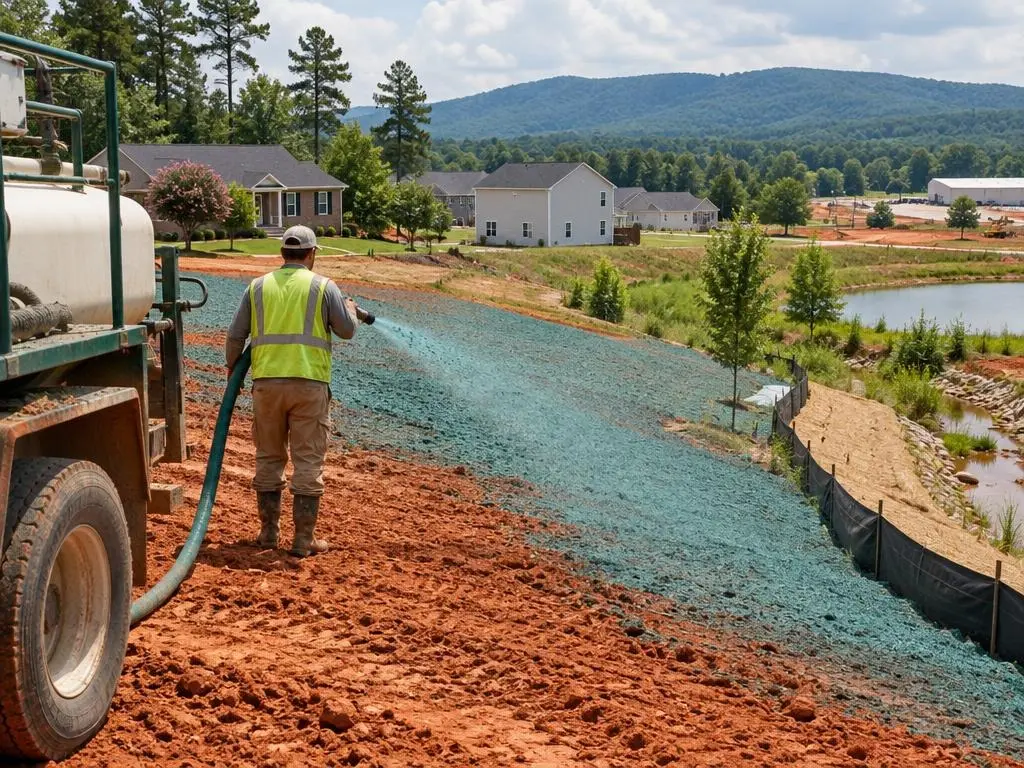
The 1991 to 2020 normals at Greenville-Spartanburg International put yearly precipitation at 49.67 inches, spread over about 117 days with measurable rain. July and August are the wettest months, at 4.82 and 4.66 inches, and summer rain tends to arrive as short, heavy thunderstorms. On a freshly graded slope, one of those storms can cut rills in an afternoon. A hydroseed slurry helps because the wood fiber mulch and tackifier glue the seed and the surface together, and the mulch holds moisture against the seed while it germinates. On steeper ground we go further, pinning down erosion control blankets or spraying a bonded fiber matrix, and on the low side of the work we set silt fence or inlet protection so mud stays on the lot instead of in the street or the nearest creek.
When to seed which grass
Greenville averages a freeze-free window of about 217 days, running roughly from April into early November, and the city falls in USDA hardiness zone 8a/8b. That long season lets us grow two different kinds of lawn. Clemson Extension sets a target of May 1 to 14 for seeding warm-season grasses anywhere in South Carolina, and mid to late September for cool-season grasses like tall fescue. Seed bermuda too early and cool soil slows it and invites seed rot. Seed it too late and it has to fight July heat as a seedling. Fescue sown in late September has the fall and the next spring to build roots before its first summer. Only some warm-season grasses can be grown from seed at all: common and improved bermuda, centipede and Japanese zoysia can, while many other zoysia and St. Augustine varieties have to go in as sod, plugs or sprigs. We will tell you which group fits your sun, shade and foot traffic before we mix a tank.
Sod, hydroseed or dry seed
Each method has a place. Sod looks like a finished yard the moment the last roll goes down, and Clemson notes it can be installed almost any time of year in South Carolina, though mid to late spring and fall are best. It also costs far more per square foot and needs heavy watering in summer. Dry seed broadcast with a spreader is the cheapest way to cover ground, but on clay it washes, birds find it, and it usually needs straw on top. Hydroseeding sits in between. It costs a little more than dry seed and generally less than sod, the fiber mulch holds the seed down and stops it drying out, and grass usually shows within 5 to 7 days in good conditions, versus two to three weeks for dry seed. On a large yard or a slope, hydroseeding is usually the practical choice. On a small strip next to a driveway that needs to look finished this weekend, sod may be the better buy, and we will say so.
Water, mud and the rules
The Reedy River rises in the foothills northwest of the city and runs south through downtown, through Lake Conestee Nature Park and on to the Saluda at Lake Greenwood. The Enoree, the Saluda and the South Pacolet also drain parts of the county. Local governments take runoff from construction seriously: Greenville County's stormwater ordinance has its own division on grading and sediment control, and some cities, Easley among them, ask even small sites disturbing less than an acre to file a stormwater permit application listing the erosion and sediment controls they will use. When your builder, the county or a city inspector needs a lot stabilized, we plan the silt fence, the seed and the mulch together so the cover comes in quickly and the fence comes out when it is no longer needed.
What a job looks like
- A site visit to check slope, drainage, access for the truck and where runoff leaves the property
- A written estimate broken out by prep, topsoil, seeding and erosion control
- Grading, ripping or tilling the clay, and topsoil where it is needed
- Hydroseeding with a mix matched to the season, plus blankets or BFM on steep ground
- Silt fence or inlet protection on the low side when water has somewhere to go
- A watering plan: short, light soakings several times daily over the first two to three weeks, then deeper and less often
After the spray
New hydroseed is green from the colorant, not from grass, so give it a week or so before judging. Keep the surface damp, not soaked, and keep dogs and kids off it. Mow for the first time once the seedlings are about a third taller than your normal mowing height, with a sharp blade so the young plants are cut instead of pulled. Wait as long as you can before spraying any weed killer, since most herbicides can hurt newly germinated grass. If a storm washes a patch out in the first couple of weeks, call us and we will look at it.
Our Services
Six kinds of work that get bare Upstate ground covered and keep it in place.
Hydroseed Lawn Installation
New lawns sprayed over prepared soil, for new builds, bare yards and lawn replacements.
Learn more →Builder & Commercial Hydroseeding
Seeding for subdivisions, commercial pads, ponds and road shoulders, scheduled around the build.
Learn more →Slope & Erosion Control
Blankets, hydromulch and bonded fiber matrix to hold red-clay slopes, swales and creek banks in place.
Learn more →Silt Fence & Inlet Protection
Silt fence, storm drain inlet protection and other sediment controls that hold construction mud on site.
Learn more →Fine Grading & Topsoil
Yard grading, topsoil, dirt work and soil prep that set up a new lawn to drain and grow.
Learn more →Lawn Renovation & Overseeding
Aeration, overseeding and patch repair to bring back thin, bare or worn lawns.
Learn more →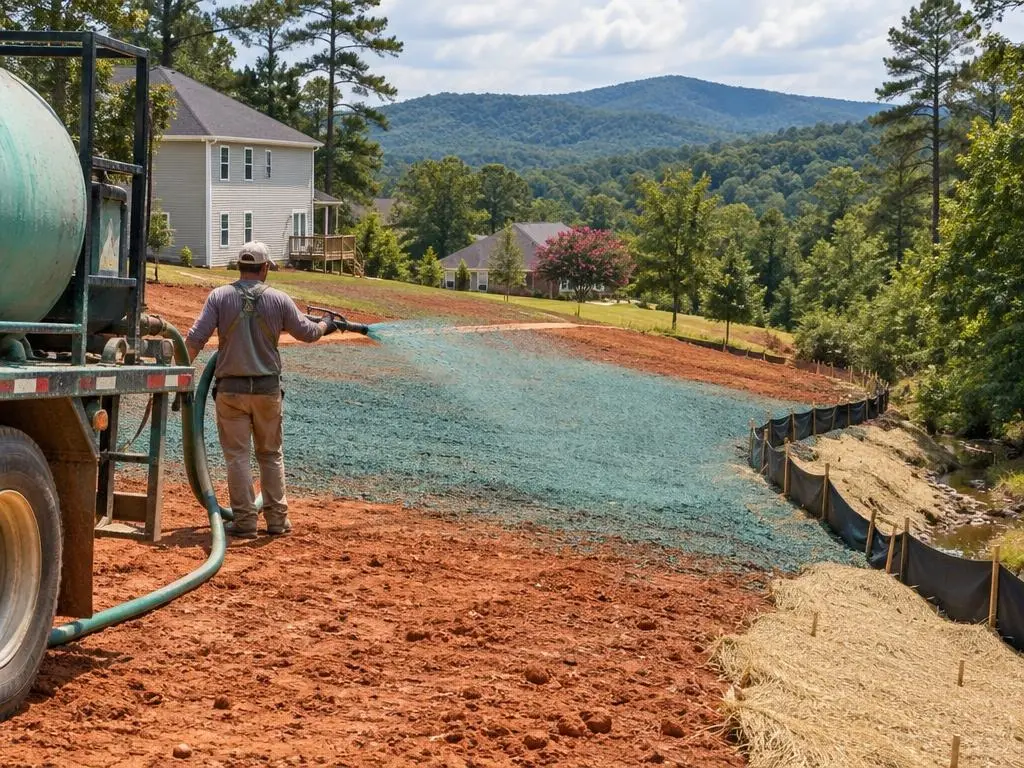
Why Homeowners Call Hydroseeding Greenville
We fix the soil first
Packed red clay gets ripped or tilled and topped with soil where needed before any seed goes down, because spraying over a hard crust is money wasted.
Seed timed to the grass
Warm-season mixes go down in late spring and fescue in early fall, following Clemson Extension's seeding dates, so seedlings are not fighting the calendar.
Erosion control in the same visit
Silt fence, inlet protection, blankets and hydromulch are planned with the seeding, not added after a storm has already moved the dirt.
Estimates in writing
Every price is written down and split by task, so you can see what the topsoil, the seed and the erosion control each cost.
Towns We Cover Around the Upstate
Most of our work is in Greenville County: the city itself, Greer, Taylors and Travelers Rest to the north and east, and Mauldin, Simpsonville, Five Forks and Fountain Inn along the I-385 corridor, where new subdivisions keep turning out bare lots. West of the Saluda we cover Easley, Powdersville, Piedmont and Pelzer, plus Pickens, Liberty, Clemson and Anderson out toward the lakes and the mountains. East of Greenville we work in Spartanburg, Duncan, Lyman, Boiling Springs, Inman and Woodruff. The ground changes as you go: steeper foothill lots near Travelers Rest and Pickens, old mill sites along the Saluda, creek-side yards on the Enoree, and big warehouse pads along I-85. Open the page for your town to read about its own soil, water and slopes, and which county's rules govern the work there.
- Hydroseeding in Greenville, SC
- Hydroseeding in Greer, SC
- Hydroseeding in Simpsonville, SC
- Hydroseeding in Mauldin, SC
- Hydroseeding in Fountain Inn, SC
- Hydroseeding in Easley, SC
- Hydroseeding in Travelers Rest, SC
- Hydroseeding in Taylors, SC
- Hydroseeding in Five Forks, SC
- Hydroseeding in Powdersville, SC
- Hydroseeding in Piedmont, SC
- Hydroseeding in Spartanburg, SC
- Hydroseeding in Duncan, SC
- Hydroseeding in Lyman, SC
- Hydroseeding in Boiling Springs, SC
- Hydroseeding in Inman, SC
- Hydroseeding in Woodruff, SC
- Hydroseeding in Anderson, SC
- Hydroseeding in Clemson, SC
- Hydroseeding in Pickens, SC
- Hydroseeding in Liberty, SC
- Hydroseeding in Pelzer, SC
Common Questions
What is the best month to hydroseed around the Upstate?
It depends on the grass. Clemson Extension's target for warm-season grasses like bermuda and centipede is the first two weeks of May, and mid to late September for tall fescue. We can spray outside those windows for erosion control, but a lawn does best when it is seeded on its own calendar.
Is there a downside to hydroseeding?
Yes. It is not instant: you wait a week or so for sprouts and several weeks before it looks like a lawn, and the seedbed has to be kept moist the whole time. It also costs more than dry seed. If you need a finished look right away, sod is the better option.
Can I hydroseed my lawn myself?
Small spray kits exist, but a truck-mounted machine mixes and agitates the slurry and lays it at an even rate over a large area. For a few hundred square feet, hand seeding with straw may be simpler. For a whole yard or a slope, the equipment and the mulch rate make the difference.
Will grass grow on red clay?
It will once the clay is loosened and fed. Packed clay sheds water and crusts after rain, so we break it up, add topsoil where needed and work in lime and fertilizer. A soil test tells us exactly how much.
Is hydroseeding cheaper than laying sod?
Usually, by a wide margin per square foot. HomeGuide's published range for hydroseeding runs between $0.12 and $0.35 a square foot, against $1 to $4 for sod installation. The figure on the written quote for your property is what you actually pay.
How soon can the kids and dog use a newly hydroseeded yard?
Hold off on any foot traffic until the grass has had its first mow, which is usually four to six weeks after spraying. Before that, the seedlings are shallow-rooted and easy to tear out.
Do I need a permit to seed my yard?
Seeding an existing lawn does not need one. Grading or clearing can, depending on how much ground is disturbed and which county or city you are in. If your project has a permit, we plan the seeding and sediment controls to match it.
Tell Us About Your Bare Ground
No-cost visits to look at the ground, and quotes on paper, anywhere in Greenville and the Upstate.