
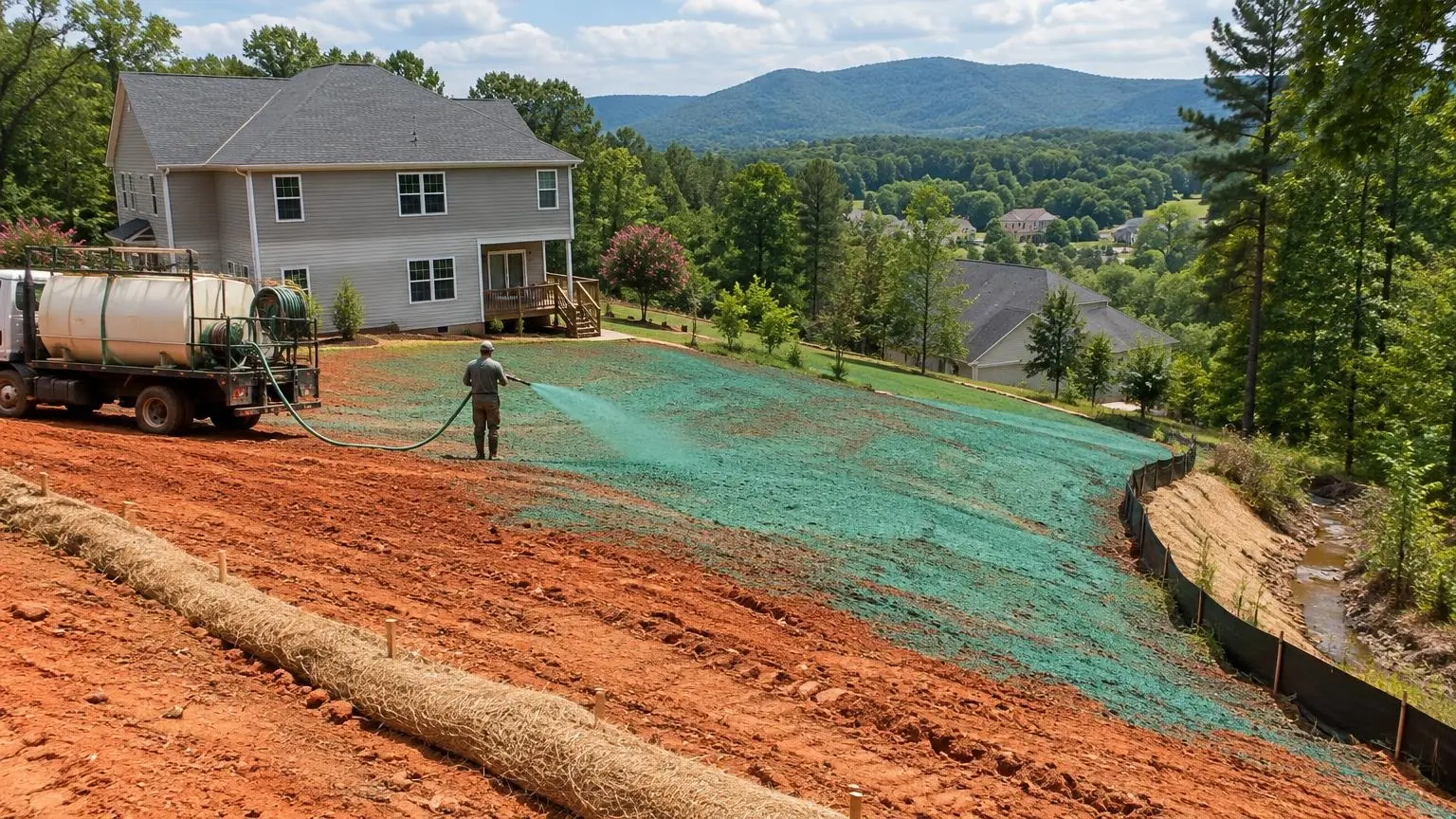
Red clay over gneiss
Hydroseeding in Spartanburg, SC
Lawn seeding built around the soil that sits under most of the city.
- We walk your site at no cost and put the quote in writing
- Seed mix chosen for your sun, shade and season
- Silt fence, blankets and grading handled by one crew
Working With Spartanburg's Red Clay
Spartanburg's most common soil series is Cecil, formed over bedrock that is mostly biotite gneiss, and any hydroseeding in Spartanburg starts with understanding it. Cecil soils have a sandy loam surface over a red clay subsoil that runs very deep. When grading strips the topsoil away, that clay is what you are left with, and it behaves very differently from the loam that was on top.
What that clay means for seed
The red clay holds nutrients reasonably well but crusts after rain and turns slick on a slope. Seed sitting on a crust dries out before it roots. We break the surface before spraying, add topsoil or compost on the worst areas and use a full hydromulch layer to stop crusting while the seed germinates.
Ridge and watershed
Morgan Square sits on the western slope of a ridge that divides the Tyger and Pacolet River watersheds. Depending on which side of that ridge your lot is on, runoff heads to a different river system. Either way it passes through creeks first, so we place silt fence and inlet protection where the water actually leaves the site.
Lawson's Fork and the gully garden
Lawson's Fork Creek winds through the area to the Pacolet, and its floodplain is considered unsuitable for development. The city also has a living example of erosion repair: Hatcher Garden and Woodland Preserve replaced an eroding gully with a garden. Bare clay slopes can head the same way if nobody covers them.
Season length
Spartanburg's growing season is about 231 days, and annual precipitation runs around 50 inches, with roughly 99 days of measurable rain a year. That is plenty of time to establish warm-season grass, and plenty of rain days to watch for when we schedule a spray.
What Spartanburg customers call about
- New lawns on infill and rebuilt lots
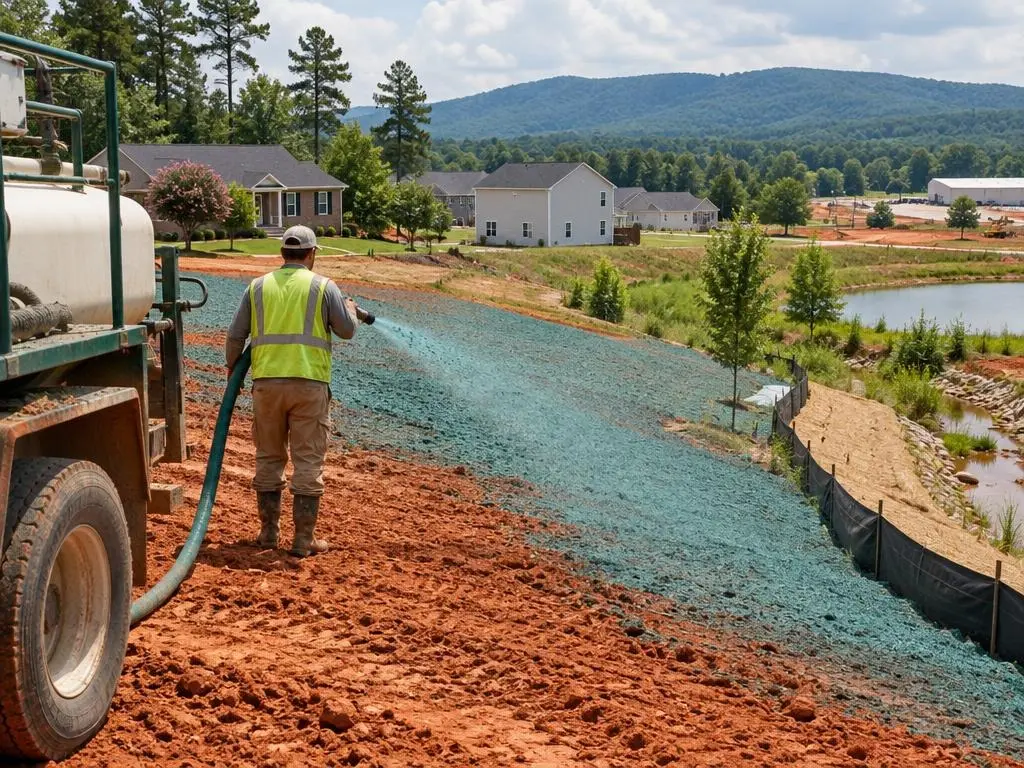
- Erosion control on cut banks and pond slopes
- Overseeding older neighborhoods near downtown
- Seeding after drainage trenching
Get a free estimate or call (864) 520-5685.
Spartanburg Soil and Water
- Cecil soil. Cecil is the most common soil series in Spartanburg, over bedrock that is mostly biotite gneiss.
- Clay subsoil. USDA describes Cecil as very deep, well drained, with a red clay subsoil under a sandy loam surface.
- Watershed divide. Morgan Square lies on a ridge separating the Tyger and Pacolet River watersheds.
- Growing season. The growing season averages 231 days, with about 98.8 precipitation days per year.
- Gully turned garden. Hatcher Garden and Woodland Preserve replaced an eroding gully with an urban woodland garden.
Spartanburg Questions
Why does my bare clay get a hard crust after rain?
Cecil subsoil seals over when raindrops hit it. Loosening the surface and covering it with hydromulch prevents that.
Do I need topsoil before hydroseeding in Spartanburg?
Where grading removed the original surface and red clay is showing, a few inches of topsoil helps a lot.
My yard drains toward Lawson's Fork. Anything special?
We put more effort into silt fence and fast cover, since creek floodplains collect whatever washes off uphill lots.
How long is the seeding season here?
The growing season runs about 231 days, so there is a long window from spring through early fall.
Hydroseeding Near Spartanburg
- Hydroseeding in Greenville, SC
- Hydroseeding in Greer, SC
- Hydroseeding in Simpsonville, SC
- Hydroseeding in Mauldin, SC
- Hydroseeding in Fountain Inn, SC
- Hydroseeding in Easley, SC
- Hydroseeding in Travelers Rest, SC
- Hydroseeding in Taylors, SC
- Hydroseeding in Five Forks, SC
- Hydroseeding in Powdersville, SC
- Hydroseeding in Piedmont, SC
- Hydroseeding in Duncan, SC
- Hydroseeding in Lyman, SC
- Hydroseeding in Boiling Springs, SC
- Hydroseeding in Inman, SC
- Hydroseeding in Woodruff, SC
- Hydroseeding in Anderson, SC
- Hydroseeding in Clemson, SC
- Hydroseeding in Pickens, SC
- Hydroseeding in Liberty, SC
- Hydroseeding in Pelzer, SC